What Are the Basics of Forex Trading for Beginners? A Clear Step-by-Step Explanation
If you’re just starting in the currency markets, learning the basics of forex trading can feel overwhelming.
This guide breaks down key concepts like currency pairs, market hours, and simple trading strategies in easy-to-follow steps.
By the end, you’ll gain a solid foundation to trade confidently and avoid common beginner mistakes. Let’s explore how to navigate the forex market with clarity and practical insights.
Key Takeaways
Forex trading becomes simple when broken down into clear, manageable steps.
This guide uses everyday language, avoiding complex financial jargon.
Gain practical insights into how currency prices move and how to trade them effectively.
We focus on building knowledge progressively, so you’re never lost.
Your main goal is to gain the confidence needed to begin your journey.
Introduction to Forex Trading for Beginners
Picture this: every single day, trillions of dollars change hands as people exchange currencies around the globe. This massive activity happens in what we call the forex market, and it’s where regular people can participate alongside big banks and corporations.
At its core, forex trading is simply exchanging one currency for another. Think of it like international travel – you swap your home currency for the local money of the country you’re visiting. This basic exchange happens millions of times daily across the world.
What makes forex unique is its 24-hour operation from Monday to Friday. Unlike stock markets with set hours, you can trade currencies early morning or late at night. This flexibility makes it accessible for people with different schedules.
The market includes everyone from central banks to individual traders working from home. Some participate for business needs, while others aim to profit from currency value changes. You don’t need huge amounts to start – many platforms allow small investments.
Your main takeaway: foreign exchange offers constant opportunities for those willing to learn. It’s an accessible market that runs around the clock. With the right approach, anyone can begin their forex trading journey.
What Are the Basics of Forex Trading for Beginners?
Before trading, it’s important to understand the key components of forex: currency pairs, how trades work, and the structure of the market. This foundation prepares you for making informed trading decisions.
You’re essentially making educated guesses about future price movements.
When you enter a trade, you’re always working with two currencies at once. This is why we call them currency pairs. You buy one while selling the other simultaneously.
The concept is straightforward. If you believe a currency will strengthen, you buy it. If you think it will weaken, you sell it. Your goal is to time these movements correctly.
Unlike stock investing where you own company shares, forex involves speculating on relative values between national currencies. Economic factors drive these price changes.
The market offers high liquidity, meaning you can enter and exit positions easily. This flexibility is one reason many traders prefer currency markets.
Your clear takeaway: Start viewing currencies as products with fluctuating values. Your job is figuring out their direction before placing trades.
Understanding the Forex Market and Key Characteristics
The global nature of forex creates some fascinating characteristics. Unlike stock markets that have set opening and closing times, currency trading operates differently. This decentralized system spans across continents and time zones.
Global Market Dynamics and 24-Hour Trading
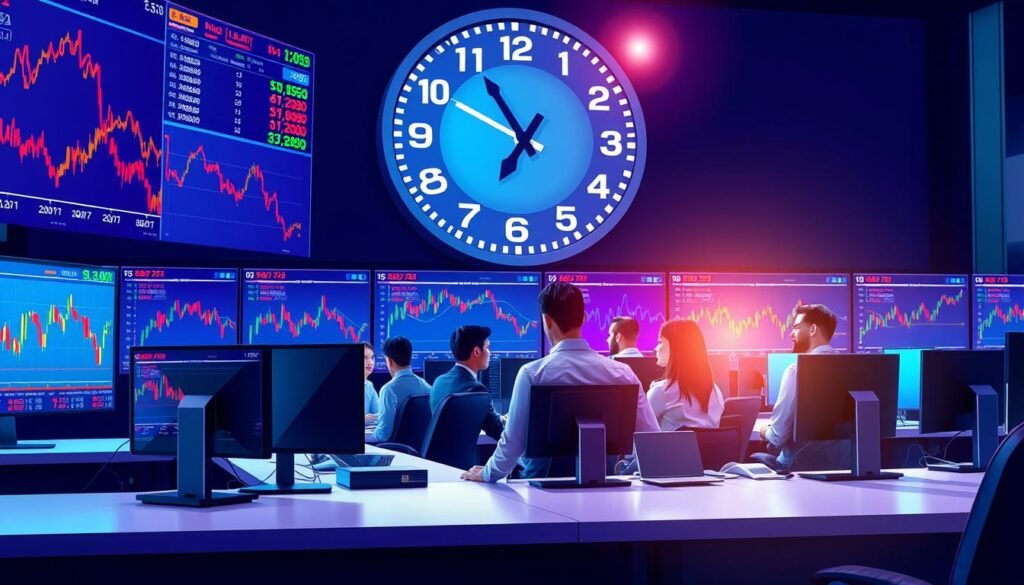
One standout feature is the non-stop operation. The forex market runs 24 hours during weekdays. It begins Monday morning in Sydney and continues through Friday evening in New York.
This continuous schedule exists because trading moves across time zones. Activity flows from Asia to Europe, then to North America. Each region has its own active trading hours.
The four main sessions are Sydney, Tokyo, London, and New York. Each has unique characteristics based on which currencies trade most actively. The London-New York overlap typically sees the highest volume.
Key Participants and Daily Turnover
The daily turnover in the forex market is staggering—recent estimates put it around $7.5 trillion, reflecting its vast global activity. This massive volume comes from diverse participants worldwide.
You’ll find central banks managing national currencies alongside multinational corporations. Hedge funds and insurance companies participate alongside individual traders. This variety creates constant liquidity and opportunity.
Your clear takeaway: The forex market’s global reach and 24-hour operation create unique trading opportunities. Focus on sessions when your preferred currency pairs show the most movement.
Essential Forex Trading Terms for Beginners
Every profession has its own vocabulary, and currency trading is no different. Let’s break down the essentials you’ll encounter daily. Mastering these terms will make everything click into place.
Think of this as learning the language before visiting a new country. Once you understand these core concepts, reading charts and placing trades becomes much clearer.
Defining Pips, Lot Sizes, and Currency Pairs
A currency pair shows how much of one currency you need to buy another. For example, EUR/USD tells you how many US dollars equal one euro.
Price movements are measured in pips. This tiny unit represents the smallest change in value. Most pairs move in increments of 0.0001.
Lot sizes determine your trade volume. Standard lots involve 100,000 units, while mini and micro lots offer smaller positions. This controls your risk exposure.
Understanding Bid, Ask, and Spreads
The bid price is what you receive when selling a currency pair. The ask price is what you pay when buying. There’s always a small difference between these two price points.
This difference is called the spread. It represents the cost of each transaction. Brokers earn through spreads rather than charging direct commissions.
Your clear action step: Write these terms down with their definitions. Refer back as you continue learning – they’ll become second nature quickly.
Breaking Down Fundamental Concepts in Forex Trading
Now let’s look at the actual units that measure movement in the currency market. Understanding pips and lot sizes is like learning the ruler and scale for your trades. These concepts are essential for calculating your risk and potential profit accurately.
Pip vs. Pipettes Explained
A pip is the standard unit for measuring a price change. For most currency pairs, it’s the fourth decimal place. If EUR/USD moves from 1.1050 to 1.1051, that’s a one-pip move.
Pairs with the Japanese yen are different. A pip is the second decimal place. Some brokers use pipettes for even finer measurement. Pipettes are the fifth decimal place. Beginners can focus on pips initially.
Standard, Mini, and Micro Lots
Lot sizes determine your trade volume. A standard lot controls 100,000 units of currency. This is a large position size. Mini lots are 10,000 units, and micro lots are just 1,000.
The lot you choose directly affects your risk. For example, a standard lot might mean a $10 profit or loss per pip. A micro lot might mean only $0.10 per pip. This control is vital for managing your money.
Your clear takeaway: Start with micro or mini lots. This lets you practice with real money while keeping risk very small. You’ll learn how pip movements affect your account safely.
Leveraging Forex Trading: Margin, Leverage, and Spread
Many beginners get confused about how traders control large positions with small accounts. The answer lies in understanding two powerful concepts: margin and leverage. These tools let you access bigger market movements than your account balance alone would allow.
How Margin and Leverage Work Together
Leverage acts like a loan from your broker. It multiplies your buying power. With 1:100 leverage, every $1 in your account controls $100 in the market.
Margin is the security deposit needed to open a position. Think of it as collateral your broker holds while your trade is active. For that $100,000 trade, you’d need $1,000 as margin.
The power of this system is clear. Small market moves create significant profits relative to your deposit. But the danger is equally real. Losses get amplified just as much as gains.
When your account balance drops too low, brokers issue a margin call. They automatically close your position to prevent further losses. This protects both you and the broker.
Your essential takeaway: Start with low leverage while learning. This reduces your risk while you build confidence in managing larger positions.
Navigating Currency Pairs: Major, Minor, and Exotic
Currency pairs come in three main flavors, each with its own characteristics and risk levels. Understanding these categories helps you choose the right pairs for your experience level.
Examples of Popular Forex Pairs
Major currency pairs always include the US dollar. They’re the most heavily traded with tight spreads. The six main pairs are EUR/USD, GBP/USD, USD/JPY, USD/CAD, AUD/USD, and USD/CHF.
EUR/USD is the most active pair globally. It represents the relationship between Eurozone and US economies. These major pairs offer excellent liquidity for trading.
Minor pairs don’t include the USD but combine other major currencies. Examples include EUR/GBP and AUD/JPY. They typically have wider spreads than major pairs.
Exotic pairs combine a major currency with one from an emerging or smaller market. Examples include USD/TRY and EUR/SEK. These pairs often have lower liquidity and wider spreads, making them more volatile than major pairs.
Your clear action: Start with one or two major pairs like EUR/USD. Get comfortable with their movements before exploring other categories.
Forex Trading Sessions and Their Impact on Market Movements
Imagine the market as a relay race that never stops. Activity passes smoothly from one major financial center to the next throughout the day. This creates distinct trading sessions, each with its own personality.
The four main sessions are Sydney, Tokyo, London, and New York. They open and close in that order. This global handoff means there’s always action somewhere.
Session Overlap and Volatility
Here’s a powerful secret: currencies move most during their “home” hours. The Japanese yen is busiest during the Tokyo session. The US dollar comes alive when New York opens.
This means your strategy should match the time. If you trade USD/JPY, focus on the overlap between the Asian and American sessions. That’s when both currencies are active.
The most explosive pricemovements often happen during the London-New York overlap. This period sees massive volume as European and American traders are both active. You can check the detailed forex trading schedule to plan your day.
Overlaps bring higher volume and tighter spreads. This creates great opportunities, but also more risk. Be prepared for faster action.
Your clear action: Align your trading schedule with the sessions that suit your chosen pairs. The London-New York window offers the highest potential for movement.
The Role of News and Economic Indicators in Forex Trading
Economic reports act like powerful waves that push currency prices in new directions. These announcements create some of the biggest movements you’ll see in the market.
High-impact news releases can cause significant price swings, sometimes moving currency pairs dozens of pips within minutes.
Understanding this relationship helps you anticipate major price shifts. It separates reactive traders from proactive ones.
Tracking Economic Events and Market Sentiment
Certain economic factors consistently move the market. The most powerful include GDP growth, unemployment data, and inflation reports. The US Non-Farm Payrolls report often creates massive volatility.
Interest rate decisions from central banks are particularly crucial. When a bank raises rates, its currency typically strengthens. Rate cuts usually weaken the exchange value.
Here’s my practical approach to news events:
Avoid opening new positions right before major announcements
Close trades near profit targets ahead of high-impact news
Tighten stop losses when you’re in a trade during event periods
Wait 30-60 minutes after releases before entering new trades
Your action step: Bookmark an economic calendar like ForexFactory. Check it daily to plan your trading around scheduled events.
Developing a Robust Forex Trading Strategy and Managing Risk
Having a solid game plan separates successful traders from those who struggle. Your trading strategy acts as your personal rulebook. It tells you exactly when to enter and exit trades.
There are several popular approaches you can choose from. Scalping involves quick trades lasting minutes. Day trading means closing all positions before the market closes. Swing trading holds trades for several days, while position trading keeps them open for weeks or months.
Risk Management Techniques for Beginners
The most critical part of your strategy is managing risk. This means knowing your maximum losses before entering any trade. A good rule is risking only 1-2% of your account per trade.
Use stop-loss orders to automatically close losing positions. Take-profit orders lock in your profit when targets hit. These tools prevent emotional decisions.
Remember: managing risk matters more than finding winners. Even professionals have losing trades. What counts is keeping losses small and letting profits grow.
Your clear action: Before your next trade, write down your entry, stop-loss, take-profit, and risk amount. Never trade without this plan.
The Importance of a Forex Trading Journal
One habit separates consistently profitable traders from the rest: meticulous record-keeping. Your trading journal becomes your personal coach, showing you exactly what works and what doesn’t.
Think of it as your financial diary. Every entry captures your decisions, emotions, and results. This creates a powerful feedback loop for improvement.
Recording and Reflecting on Your Trades
After each trade, document these key details:
Entry and exit points with exact time stamps
The strategy you used for that specific trade
Your emotional state during the position
Whether you followed your original plan
This process transforms random trades into valuable learning experiences. You’ll spot patterns in your behavior that affect your results.
Professional traders often use specialized platforms like Edgewonk for automated tracking. These tools analyze your performance statistics objectively.
Your clear action: Start your journal today, even with demo accounts. Record every trade honestly to build disciplined habits from day one.
Personal Insights
When I first started trading forex, I remember feeling completely overwhelmed by all the terms, charts, and market hours.
What helped me most was focusing on one small piece at a time—like understanding pips or practicing with micro lots—before trying to do everything at once.
I quickly learned that keeping a simple journal of each trade, including what I felt and why I entered, gave me insights I wouldn’t have noticed otherwise.
Looking back, those small, consistent steps built both my confidence and my ability to make clearer decisions in the market.
Choosing a Reliable Forex Broker and Trading Platform
Your choice of trading partner matters more than you might think. A good broker provides your gateway to the market. They connect you to global currency flows through their software.
Most brokers earn through the spread—the difference between buy and sell prices. You’ll always pay slightly above market price when buying. When selling, you receive slightly less. Tight spreads keep your costs low.
Proper regulation by authorities like the CFTC or NFA
Competitive spreads on major currency pairs
User-friendly interface with powerful charting tools
Multiple account types matching different experience levels
MetaTrader 4 remains the most popular platform worldwide. It offers advanced indicators and automated trading options. Many brokers support MT4 alongside their own custom software.
Your clear action: Research three different brokers. Compare their spreads, check regulation status, and test their platforms with demo accounts before funding your live trading account.
Tips for Opening Your First Forex Account
Getting your first trading account set up properly makes all the difference in your early experience. You have two main options: demo accounts with virtual money or live accounts with real funds. Starting with a demo account lets you practice in real market conditions risk-free.
Treat your demo account seriously from day one. Use the virtual funds as if they were real money. Practice your risk management and track your results carefully. Most platforms offer $10,000 to $100,000 in practice money.
When you feel consistently comfortable with your demo results, consider moving to a live account. Many brokers allow accounts with as little as $100, though requirements vary—some offer even smaller minimum deposits.
This keeps your risk manageable while you adjust to real market emotions.
Before funding your account, master the platform’s essential features. Know how to open and close positions, set stop-loss orders, and monitor your trades. Understanding these tools prevents costly mistakes when real money is involved.
Your clear action: Open a demo account this week if you haven’t already. Practice for 30-60 days until you feel confident, then start small with a live account when you’re ready.
Avoiding Common Pitfalls in Forex Trading
I want to share the errors I see new traders make repeatedly – so you can skip them entirely. Learning from others’ mistakes is faster than making them yourself. This knowledge protects your account while you build experience.
One major trap is using too much leverage. Just because your broker offers high ratios doesn’t mean you should use them. High leverage amplifies both profits and risk dramatically.
Another common mistake involves stop-loss orders. Never move them further away when a trade goes against you. This turns small losses into account-threatening ones when the market moves unexpectedly.
The psychology of taking profits too early is equally dangerous. Many new traders exit winning positions quickly out of fear. Yet they hold losing trades hoping they’ll recover.
Successful traders do the opposite: they cut losses short and let profits run. Exit losing trades according to your plan. Give winning trades room to grow beyond initial targets.
Overtrading is another emotional trap. Taking too many trades out of boredom or frustration leads to more losses. Stick to your strategy rather than chasing quick recovery.
Also avoid entering trades after missing your ideal setup. Chasing the market usually means buying high right before a reversal. If you miss an entry, wait for the next opportunity.
News events create volatility that can trigger stops or cause slippage. Always check an economic calendar before trading during high-impact announcement times.
Your protection plan: Write these common mistakes where you can see them. Before each trade, ask if you’re about to make any of these errors. This simple habit builds disciplined trading from day one.
Enhancing Your Forex Trading Skills and Knowledge
The best traders I know treat learning as their most valuable asset. Your growth in this field depends on the resources you use and the habits you build.
Educational Resources and Demo Accounts
Quality education separates successful traders from the rest. Many brokers offer free academies with courses covering everything from basic concepts to advanced analysis.
Demo accounts let you practice in real market conditions without risking your funds. You can test new strategies and build confidence safely.
Daily market analysis helps you understand what moves prices. Reading commentary builds your ability to anticipate market movements.
Consider specializing in a style that fits your personality. Day trading captures quick profits, while swing trading holds positions for several days.
Your growth plan: Commit to 30 minutes daily on education. Consistent learning compounds into expertise over time.
Conclusion
You’ve reached the final step of your beginner’s journey, and I’m genuinely proud of your progress. Together, we’ve explored how the forex market operates across the world and why currency values change throughout the day.
Remember that successful forex trading comes down to disciplined execution. Start with demo accounts to practice without pressure. Focus on one or two major pairs until you feel confident reading price movements.
Your path forward is clear: develop a simple strategy, manage risk on every trade, and keep learning. This guide gives you the foundation – now it’s time to build your experience through consistent practice.
The most valuable skill you can develop is patience. Real profit comes from steady growth, not quick wins. Trust the process we’ve outlined together.
Disclaimer: This article is for informational and educational purposes only and does not constitute financial, investment, or legal advice. Always conduct your own research and consult a qualified professional before making any financial decisions.
FAQ
What is the best time of day to trade forex?
The best time is usually when two major trading sessions overlap, like the London and New York sessions. This is when the market is most active, with higher volume and more price movements, giving you better trading opportunities.
How much money do I need to start trading forex?
You can start with a surprisingly small amount. Many brokers offer micro accounts where you can begin with just a small deposit. The key is to start with money you can afford to lose and use proper risk management on every position.
What’s the difference between a demo account and a live trading account?
A demo account uses virtual funds, so it’s perfect for practicing your strategy without any real financial risk. A live account involves your actual capital. I always recommend starting with a demo to build confidence before switching to real money.
Why is leverage considered both powerful and risky?
Leverage lets you control a large position with a small amount of capital, which can magnify your profits. However, it also magnifies your losses just as quickly. That’s why understanding and managing your margin is absolutely essential for survival.
How do I choose a reliable forex broker?
Look for a broker that is well-regulated by a major authority, offers a user-friendly platform like MetaTrader 4 or 5, has transparent fees, and provides good customer support. Reading independent reviews can also help you make a smart choice.
What is a pip, and why is it so important?
A pip is the smallest price move a currency pair can make. It’s how we measure profit and loss. Understanding pips helps you calculate your potential risk and reward before you even enter a trade, which is a fundamental skill.
What should I look for in a trading strategy?
A good strategy is simple, clear, and includes specific rules for entering and exiting trades. Most importantly, it must have strict risk management rules to protect your account from large, unexpected losses.
How often should I check economic news as a beginner?
Start by checking an economic calendar once a day to see what major events are coming up, like central bank announcements or employment reports. You don’t need to watch the news constantly, but being aware of high-impact events can help you avoid sudden market volatility.
 Skip to main content