Forex Trading Basics for Beginners: Guide to Getting Started Safely
If you’re new to currency markets, understanding forex trading basics for beginners is the first move toward trading with confidence instead of guesswork.
Forex trading involves buying and selling currencies to profit from price changes, but without clear guidance, it can quickly feel overwhelming.
In this guide, you’ll learn how the forex market works, essential terms, risk management principles, and the exact steps to start safely.
Let’s explore how to build your foundation and enter the market the right way.
Key Takeaways
This guide breaks down the global currency exchange market in simple, easy-to-understand language.
You will learn a safe and methodical approach to participating in this financial activity.
The focus is on building real knowledge and skills, not on unrealistic profit promises.
We cover the entire process from setting up a practice account to executing a transaction.
Essential risk management principles are included to help you protect your capital.
The aim is to leave you feeling informed, prepared, and confident to begin.
Understanding Forex Trading
At its core, foreign exchange is about simultaneous buying and selling. It’s not like traditional stock markets with physical locations. Instead, it operates through a global network of banks.
What is Forex Trading?
This activity involves exchanging one currency for another. You’re always dealing with two currencies at once. When you buy EUR/USD, you’re purchasing euros while selling dollars.
The global currency market operates 24 hours a day during weekdays, opening Monday and closing Friday, as trading moves across major financial centers worldwide.
As New York closes, Tokyo or London opens. This creates continuous trading opportunities.
Key Concepts and Terminology
You’ll encounter specific terms that are essential to understand. A currency pair shows the exchange rate between two currencies. For example, EUR/USD tells you how many dollars you need for one euro.
Here are the most important terms to know:
Pip: The smallest price movement a pair can make
Spread: The difference between buying and selling prices
OTC market: Over-the-counter network without central exchange
Your main takeaway: This market connects buyers and sellers worldwide. Understanding these basics prepares you for confident participation.
The Importance of a Demo Account
Imagine having a practice space where you can make all the beginner mistakes without losing real money. This is exactly what a demo account provides. It’s your personal training ground for learning currency markets.
Starting with a demo account gives you virtual funds to work with. Most platforms provide virtual funds for practice, typically ranging from $10,000 to $100,000 depending on the broker.
You get to trade real currency pairs without any actual financial risk.
Benefits of Paper Trading
Paper trading lets you explore the platform’s full features safely. You can test different order types and charting tools. This demo period helps you understand how leverage works before it can impact your real funds.
New traders often discover their personal style during this phase. Some prefer quick decisions while others like longer positions. The demo account lets you experiment with various approaches.
How to Set Up Your Demo Account
Setting up your demo account takes just minutes. Choose a reputable platform and complete a simple registration. You’ll typically get immediate access to start practicing.
Your demo includes live news feeds and market analysis. You can practice risk management with stop-loss orders. This creates a complete learning environment without pressure.
Spend serious time with your demo account before moving to real funds. It’s the safest way to build confidence and develop effective strategies.
Setting Up Your Forex Trading Platform
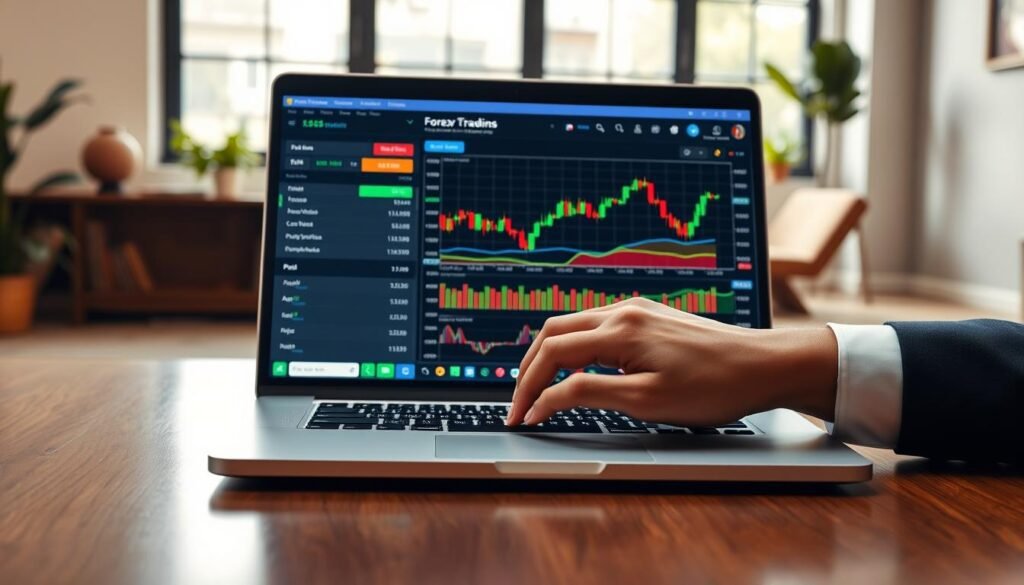
Before placing any trades, you need a reliable platform that fits your lifestyle. This is your main workspace for everything currency-related. Think of it as your personal command center.
Your chosen platform determines how smoothly you can analyze markets and execute decisions. It’s worth taking time to find one that feels intuitive.
Choosing Between Web and Mobile Platforms
Most brokers offer three main ways to access their services. You can use a web browser, a mobile app, or advanced software like MetaTrader 4. Each option serves different needs.
The web-based platform works directly in your browser without downloads. It’s perfect if you mainly trade from a computer. You get full access to charts and tools instantly.
Mobile apps let you monitor positions and react to market moves from anywhere. This flexibility is incredibly useful when you’re away from your desk. You never miss important opportunities.
The best platforms can be customized to match your preferences. You can set price alerts, arrange charts your way, and configure risk tools. Start with the basic features on your demo account and explore advanced options gradually.
Your takeaway: Pick a platform that matches how you live and trade. Master it thoroughly with virtual funds before using real money.
How to Open a Live Forex Trading Account
Ready to move from practice to real action? Opening your live account is the next logical step. This process feels significant, but the actual steps are surprisingly straightforward.
You’ll begin by completing an online application with your chosen broker. This form asks for basic personal details and some financial information about your experience level.
Application and Verification Process
Brokers must verify your identity to comply with regulations. You’ll need to upload documents like a government ID and proof of address. This security step protects everyone involved.
Verification typically takes a few hours to two days. Some platforms use automated systems for instant approval.
Once approved, you’ll fund your account. Brokers offer multiple deposit options including bank transfers, cards, and e-wallets. Choose the method that works best for you.
Pay attention to different account types available. They vary in minimum deposits, leverage levels, and tool access. Select an option matching your budget and goals.
Remember: Start with funds you can afford to risk. Never use money needed for essential expenses. This careful approach sets you up for sensible participation in currency markets.
Forex Trading Basics For Beginners
Having a clear roadmap prevents overwhelm and keeps you moving forward safely. I’ll walk you through the entire sequence, from your first lesson to your first real transaction.
This isn’t about rushing. It’s about building a solid foundation that protects you while you learn.
Your Learning Path
Start by understanding the core concepts. Learn the terminology and what makes prices move. Economic reports and world events play a big role.
Next, find a trustworthy broker. They are your gateway to the market. Look for strong regulation and good customer support.
Then, open a demo account. This is your safe space to practice. Use virtual money to test strategies and learn from mistakes.
Develop a plan that fits your personality. Decide if you prefer quick moves or longer holds. Always include risk management rules.
Starting With Confidence
Only open a live account after consistent demo success. Fund it with money you can afford to risk. Begin with small positions.
Your first real trades should follow your plan exactly. Resist the urge to take big risks. Treat every outcome as a learning experience.
Safety means never skipping the practice phase. Use stop-loss orders on every trade. Limit your risk on any single decision.
Your takeaway: Follow this path without shortcuts. You’ll gain the confidence and skills needed for long-term participation.
Developing Your Trading Strategy
Having a clear plan for your market moves is what separates thoughtful participants from random guessers. Your personal game plan is called a trading strategy. It tells you exactly when to enter and exit positions.
This approach keeps you objective when money is involved. You’ll avoid emotional decisions that often lead to losses. A solid strategy becomes your reliable guide.
Trend and Breakout Strategies
One popular method is trend trading. You analyze historical price movements to identify market direction. Then you trade with the trend rather than against it.
Breakout strategies focus on key price levels. You watch for moments when prices move beyond support or resistance. This often signals strong upcoming movements.
Other approaches include range trading and momentum strategies. Range trading works when markets bounce between two price levels. Momentum trading looks at how strongly prices are moving.
Customizing Your Approach
No single trading strategy works for everyone. Your personality and available time matter greatly. Patient people might prefer longer-term approaches.
If you have limited screen time, consider strategies requiring less monitoring. Always match your approach to your risk tolerance. What feels comfortable for others might not work for you.
Test different strategies on your demo account first. Find one or two that match your style and consistently deliver results. Stick with them and refine over time rather than constantly switching approaches.
Risk Management in Forex Trading
Think of risk management as your financial seatbelt—it’s what keeps you safe when markets get bumpy. Many people get excited about potential profits, but protecting your capital is what separates successful participants from those who don’t last long.
I want to share the tools that help you stay protected. These aren’t complicated strategies—they’re simple habits that can save your account.
Using Stop-Loss and Take-Profit Orders
Stop-loss orders automatically close positions when prices move against you. They limit your potential losses to amounts you’re comfortable with. This prevents emotional decisions during market volatility.
Take-profit orders work in the opposite direction. They lock in gains when prices reach your target. This helps you avoid greed that can turn winning trades into losses.
Managing Leverage and Exposure
Leverage lets you control large positions with small capital. While this sounds powerful, it magnifies both profits and losses. Many professionals recommend risking only 1-2% of your account per trade.
Margin requirements determine how much capital you need for each position. With 2% margin, you control $100,000 with just $2,000.
Retail traders are protected from losing more than their account balance, but rapid market movements can still wipe out your deposited funds if risk is not managed carefully.
I suggest starting with lower leverage until you gain experience. Always calculate potential losses before entering any position. For deeper insights, explore these effective risk management techniques from financial experts.
Your key takeaway: Protect every trade with stop-loss orders, respect leverage’s double-edged nature, and never risk more than you can afford to lose. Capital preservation should always come before profit chasing.
Understanding Currency Pairs and Price Movements
Every decision you make in the currency market revolves around one simple concept: currency pairs. These pairs show you exactly how different currencies relate to each other.
Think of them as the basic building blocks that make everything else possible. Once you understand how pairs work, the whole market starts making more sense.
How Currency Pairs Work
A currency pair shows the exchange rate between two different currencies. The first currency listed is called the base currency, while the second is the quote currency.
For example, if EUR/USD shows 1.11280, it means one euro equals 1.11280 US dollars. You’re always dealing with the relationship between two currencies at once.
When you buy a currency pair, you’re actually doing two things simultaneously. You’re buying the base currency while selling the quote currency.
Price movements are measured in tiny increments called pips. These small changes add up when you’re working with larger amounts.
Major currency pairs like EUR/USD and GBP/USD attract the most activity. They typically have tighter spreads and more predictable movements.
Your takeaway: Start by mastering one or two major pairs. Learn how they typically behave before exploring more complex options.
Technical Analysis Tools for Forex
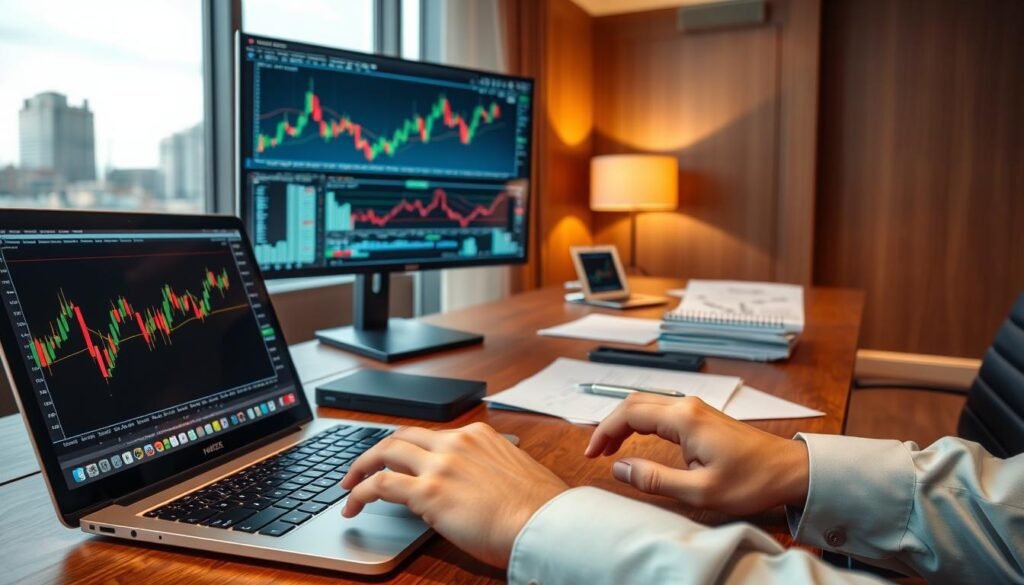
Picture this: you’re looking at a screen full of colorful lines and numbers that tell a story about where prices might go next. This is technical analysis in action – using charts and indicators to understand market behavior.
Your demo account gives you access to all these powerful tools. You can practice reading price movements without any risk.
Charts, Indicators, and Trends
The most basic tool is the price chart itself. You can view markets in different timeframes depending on your style. Some people watch quick 5-minute moves while others prefer daily charts.
There are three main chart types to explore. Line charts show simple closing prices. Bar charts display open, high, low, and close data. Candlestick charts are most popular for their visual clarity.
Technical indicators are mathematical helpers that spot patterns. Moving averages show trend direction. RSI measures whether markets are overbought or oversold.
Start with just one or two indicators rather than overwhelming yourself. Learn to read basic candlestick patterns first.
Support and resistance levels act like price floors and ceilings. These are points where markets historically struggle to move past.
Your takeaway: Master simple tools before adding complexity. Consistent practice with charts and indicators builds confident decision-making skills.
Personal Insights
When I first started with forex, I underestimated how much time it takes to feel truly comfortable with the platform and the mechanics of trading.
Spending hours on my demo account, experimenting with different strategies and watching how small changes affected outcomes, taught me patience in a way no textbook could.
I also learned that it’s easy to get caught up in potential profits, but stepping back and reviewing trades objectively helped me see patterns I’d otherwise miss.
Over time, these small, deliberate practice sessions gave me the confidence to approach real trading without panic or rush.
The Role of Economic Events in Forex Movement
The connection between world events and currency price changes is stronger than many people realize. Economic announcements create immediate reactions across global markets.
When central banks adjust interest rates, currencies respond quickly. Higher rates typically strengthen a currency by attracting foreign investment. Lower rates often have the opposite effect.
Employment reports like the U.S. Non-Farm Payrolls signal economic health. Strong job numbers usually boost a country’s currency. Weak employment data can send prices lower.
Inflation data and GDP releases also drive significant movements. These indicators show whether an economy is growing or struggling. Traders watch them closely for trading opportunities.
Geopolitical events create sudden volatility. Elections, trade talks, and international conflicts cause rapid price swings. Uncertainty leads to dramatic market reactions.
Major announcements can cause sharp price movements within minutes, sometimes resulting in significant pip swings depending on market conditions and liquidity.
This volatility requires careful planning. Many participants avoid trading during key releases.
Always check economic calendars before making decisions. These free tools show scheduled data releases. They help you prepare for potential market turbulence.
Your takeaway: Economic news often overrides technical analysis in the short term. Decide whether to trade through events or wait for stability.
Choosing the Right Forex Broker
Finding the right platform provider is one of the most important decisions you’ll make on this journey. Your broker acts as your gateway to the markets, so choosing wisely protects your funds and trading experience.
Evaluating Broker Credentials
Always start by checking regulation. Look for brokers authorized by respected bodies like the CFTC, FCA, or ASIC. This ensures they follow strict rules and keep your money secure.
Proper regulation means your funds are protected from manipulation. Unregulated providers might delay withdrawals or offer unfair pricing. Safety should always come first.
These regulators enforce strict rules on fund segregation, reporting standards, and client protection policies.
Understanding Spreads and Fees
Costs matter more than you might think. The spread—difference between buy and sell prices—directly impacts your profits. Lower spreads mean better value for active traders.
Look beyond just spreads. Some brokers charge commissions, overnight fees, or withdrawal costs. These hidden expenses can add up quickly. Always read the full fee schedule before committing.
Do thorough research before selecting any provider. Check independent reviews and test customer support. For detailed guidance, explore this comprehensive broker selection resource.
Your takeaway: Verify regulation, compare costs transparently, and start small until you’re confident in your chosen platform.
Common Pitfalls for New Traders
There’s a pattern to the challenges that face people new to currency markets. I want to help you spot these traps before they cost you money. Recognizing these common errors early can save your account and confidence.
Overleveraging and Emotional Trading
Using too much leverage is the fastest way to wipe out an account. It magnifies every price movement, turning small dips into major losses. Many beginners underestimate this risk when they start.
Emotional decisions often destroy more accounts than bad strategies. Fear, greed, or chasing losses can lead to impulsive trades. Stick to your plan even when markets get volatile.
The revenge trading trap happens after a loss. People jump back in with bigger positions trying to recover quickly. This usually creates even larger losses instead.
Mistakes to Avoid in Live Trading
Jumping into live markets without enough practice is dangerous. It’s like driving on the highway after only reading about cars. Spend serious time with demo accounts first.
Following unverified advice from social media “gurus” can lead to disaster. Verify sources before acting on any recommendations.
Overtrading from boredom or impatience racks up costs. Not every moment requires action. Sometimes the best move is waiting for the right setup.
Your key takeaway: Patience and discipline beat impulsiveness every time. Use stop-loss orders, manage your risk carefully, and remember that consistent small gains build real success.
Expanding Your Forex Knowledge
Your learning journey doesn’t end when you place your first real trade. The most successful traders in the world treat education as an ongoing process. They constantly adapt their strategies to changing market conditions.
Quality resources can dramatically accelerate your growth. Structured courses from platforms like IG Academy take you from basic concepts to advanced techniques. These programs cover everything from terminology to complex risk management.
Educational Resources and Courses
Online learning platforms offer comprehensive lessons that build your skills systematically. You’ll find video tutorials, interactive quizzes, and live webinars. Many brokers provide these resources completely free to their clients.
Look for courses that include practical exercises. The best programs let you apply new strategies in simulated environments. This hands-on approach helps knowledge stick much better than passive reading.
Books and Expert Guides
Books written by experienced professionals offer deep insights you won’t find elsewhere. They share real-world lessons about psychology, analysis methods, and proven strategies. Learning from others’ experiences helps you avoid common mistakes.
Legendary traders like George Soros and Stanley Druckenmiller didn’t rely on secret formulas. Their success came from deep market understanding and disciplined risk management. Their stories teach valuable lessons about adapting to economic changes.
Your key takeaway: Make continuous learning part of your routine. Combine courses, books, and practical experience to keep growing your skills over time.
Conclusion
As we wrap up this guide, you now have a solid starting point for your journey into currency markets. You’ve learned the essential building blocks from understanding pairs to managing risk.
Remember that success in this space takes time and consistent effort. It’s not about quick wins but developing lasting skills. Patience and discipline will serve you better than chasing immediate profits.
Your demo account practice lays the foundation for confident live trading. Stick to your plan, use stop-loss orders, and learn from every decision. Each trade teaches you something valuable.
The real opportunity comes from treating this as a serious learning process. Keep educating yourself, stay curious about market movements, and build your skills gradually.
You’re equipped to begin safely and smartly. Trust the process, manage your risk carefully, and give yourself the time needed to grow. Your journey starts with these solid fundamentals.
Disclaimer: This article is for informational and educational purposes only and does not constitute financial, investment, or legal advice. Always conduct your own research and consult a qualified professional before making any financial decisions.
FAQ
What is the foreign exchange market?
The foreign exchange market is where you can buy and sell different currencies. It’s the largest financial market in the world, operating 24 hours a day. Think of it as a global marketplace for national currencies.
Why should I start with a demo account?
A demo account lets you practice with virtual funds, so you can learn the platform and test strategies without risking real money. It’s the safest way to build confidence before you start a live account.
How do I choose a good broker?
Look for a broker that is well-regulated, has a user-friendly platform, and offers clear information on spreads and fees. Good customer support and educational resources are also key signs of a reliable partner.
What is a currency pair?
A currency pair shows the value of one currency against another, like EUR/USD. The first currency is the ‘base,’ and the second is the ‘quote.’ You’re essentially speculating on whether the base currency will strengthen or weaken against the quote.
What is leverage and why is it risky?
Leverage lets you control a large position with a small amount of your own capital. While it can amplify profits, it also magnifies losses dramatically. Proper risk management is absolutely essential when using leverage.
What’s the simplest way to manage risk?
Always use stop-loss orders. This tool automatically closes your trade at a predetermined price if the market moves against you, limiting your potential loss on any single position.
How much money do I need to start?
You can begin with a surprisingly small amount, especially with a micro account. The real key isn’t the initial deposit, but having enough extra funds so that a single loss doesn’t wipe out your account.
What is technical analysis?
Technical analysis involves studying charts and using indicators to identify patterns in price movements. It helps traders make educated guesses about where the price might go next based on past behavior.