How to Start Forex Trading for Beginners: A Simple Step-by-Step Guide to Your First Trade
Learning how to start forex trading for beginners step by step can feel overwhelming at first, but it becomes much easier with a clear process.
This guide explains how the forex market works, what tools you need to begin, and how to place your first trade with confidence. You’ll also learn basic risk management principles and common mistakes to avoid so you can start trading with a solid foundation.
Key Takeaways
The forex market is the largest financial market in the world, with an average daily turnover of over $7.5 trillion. The U.S. dollar is involved in about 89% of all forex transactions, making it the dominant currency in global exchange trading.
Understanding the basics before you begin is crucial to avoiding common beginner mistakes.
This guide provides a clear, simple path from learning the fundamentals to executing a real trade.
Forex trading is accessible but requires discipline and a solid plan to approach responsibly.
You can start this journey with confidence, equipped with practical knowledge and honest advice.
Understanding the Forex Market
The foreign exchange market is unique because it doesn’t have a single home like the New York Stock Exchange. Instead, it’s a massive electronic network connecting banks and traders worldwide. This is what we call an over-the-counter, or OTC market.
What is Forex Trading?
Simply put, forex trading is exchanging one currency for another. You’re always dealing with currency pairs, like EUR/USD. You speculate that one currency‘s value will change relative to the other.
Your goal is to profit from these movements in the exchange rate. This activity is the engine of the entire global forex market.
Global Trading Centers and 24-Hour Accessibility
Major financial hubs like New York, London, Tokyo, and Sydney power this market. As one center closes, another opens. This creates a cycle that keeps the market active 24 hours a day during the week.
This non-stop operation means you can find trading opportunities at almost any time. It offers incredible flexibility that other markets don’t have.
Your main takeaway? The forex market is a decentralized, global network for exchanging currencies in pairs, and it never sleeps during the trading week. That’s your foundation.
Benefits and Risks of Forex Trading
Every financial opportunity carries its own set of advantages and challenges, and forex is no exception. Understanding both sides helps you make smarter decisions from day one.
Pros of Trading Forex
The currency market offers incredible liquidity. This means you can enter and exit positions quickly without significant price changes.
You get 24/5 access to global markets with relatively low starting capital. The ability to explore forex trading opportunities on your schedule provides flexibility that stock markets can’t match.
Leverage allows you to control larger positions with less money. This can amplify your potential profits when trades move in your favor.
Potential Risks and Volatility
That same leverage that boosts profits can also magnify losses dramatically. A small price move against your position can wipe out your entire account.
Currency markets experience extreme volatility. Major unexpected events can cause sudden volatility — for example, in 2015 the Swiss franc surged sharply after the Swiss National Bank removed its euro peg, leading to significant market disruption. While such extreme moves are rare, volatility is a real risk.
You’re competing against institutional traders with superior technology and information. Emotional decisions and over-leveraging account for most beginner losses.
The key takeaway? Respect both the power and the peril. Proper risk management turns potential dangers into calculated opportunities.
How To Start Forex Trading For Beginners Step by Step
Taking your first steps in the market requires a clear, structured approach. Breaking a big goal into smaller tasks makes it feel much more achievable.
Breaking Down the Process
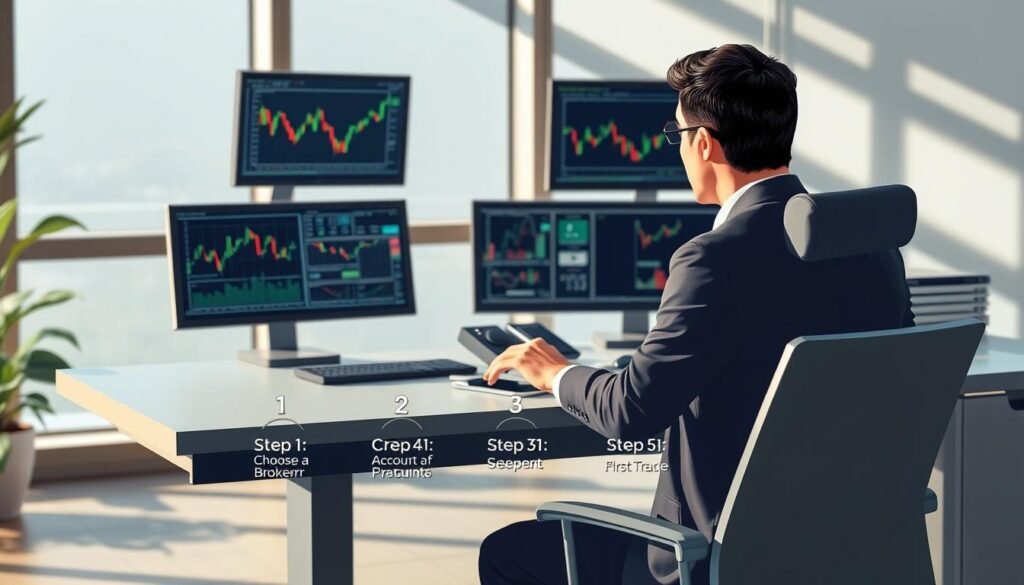
Follow this sequence to build your skills safely. It prioritizes learning before risking real capital.
Grasp the fundamentals. Understand currency pairs, what makes prices move, and the basic language of the market. This guide and other solid educational resources are your starting point.
Select a regulated broker. Your broker is your gateway to the markets. Choose one that is trustworthy and offers a platform you find easy to use.
Practice with a demo account. This is your risk-free training ground. Test your ideas, learn the platform, and get comfortable without financial pressure.
Build your personal strategy. Decide which pairs you’ll focus on and define your rules for entering and exiting a position. Your plan is your roadmap.
Once you feel confident in your demo results, begin with a very small amount of real money. The goal is to adapt to the psychology of real gains and losses.
The key is progression, not speed. A methodical approach from education to small live trades builds a foundation for long-term success.
Setting Up Your Forex Trading Account
Before you can place a single trade, you need to establish your home base in the market. This means choosing where you’ll execute your trades and getting your account ready for action.
Choosing a Reputable Broker
Your broker is your partner in this journey. I always look for three key things when selecting one. First, they must be regulated by authorities like the CFTC in the U.S. This protects your funds and ensures fair play.
Second, check their trading platform. It should feel intuitive, not confusing. You’ll spend hours there, so ease of use matters.
Finally, compare costs like spreads and commissions. Lower costs mean more profit stays in your pocket.
Regulation: CFTC or FCA oversight for security
Platform: User-friendly interface you can navigate easily
Costs: Competitive spreads and transparent fees
Demo vs. Live Accounts
Every quality broker offers both demo and live accounts. The demo account uses virtual money in real market conditions. It’s your risk-free training ground.
I recommend spending several weeks practicing here. Test strategies and learn the platform without financial pressure.
When you’re consistently profitable on demo, transition to a live account with small amounts. The psychological shift is real – emotions change when real money is involved.
Your takeaway: Choose a regulated broker with good tools, master the platform on demo, then start live with money you can afford to learn with.
Navigating the Trading Platform
Think of your trading platform as your personal command center for the markets. It’s where you’ll watch price movements, place orders, and manage everything. Getting comfortable here before using real money is essential.
Platform Overview and Features
Most brokers offer several platform options to suit your needs. You can access web-based versions through your browser, download desktop software, or use mobile apps for trading anywhere.
Popular choices like MetaTrader 4 provide advanced charting and automated strategy options. When you log in, you’ll see live quotes, interactive charts, and order panels.
Customization is key. You can set up watchlists, choose timeframes, and create alerts for specific price levels. This personalization makes the platform work for your unique approach.
Utilizing Technical Analysis Tools
Your platform comes packed with technical analysis tools to help spot opportunities. Indicators like moving averages and RSI show trends and momentum patterns.
Spend time in demo mode exploring these features. Practice placing trades and adjusting chart settings until everything feels natural.
Your takeaway: Master your trading platform completely before going live. Know where every tool is located so you can act confidently when real opportunities appear.
Developing Your Trading Strategy
Your trading strategy acts as your personal roadmap through the currency markets. It defines exactly what you’ll trade, when you’ll enter positions, and how you’ll manage risk. This game plan keeps you focused when emotions try to take over.
A clear strategy removes guesswork from your decisions. You’ll know your rules for every scenario that might arise during your trading sessions.
Fundamental Analysis vs. Technical Analysis
There are two main ways traders analyze the forex market. Technical analysis studies price charts and patterns. You look at trends, support levels, and indicators to spot opportunities.
Fundamental analysis examines economic data and global events. This includes interest rate decisions, employment reports, and political developments that affect currency values.
Most successful traders combine both approaches. They use fundamental analysis to understand the big picture. Then they apply technical analysis to time their specific entry and exit points.
Your strategy should match your personality and schedule. If you can watch charts all day, short-term styles like scalping might work. With a busy job, swing trading or position trading could be better fits.
Your takeaway: Build a strategy that blends analysis methods you understand. Make sure it fits your available time and includes clear rules for every trade you take.
Creating a Trading Plan and Managing Risk
The most important document you’ll create isn’t a trade ticket – it’s your personal trading plan. This written guide removes emotion from your decisions and gives you structure for every position you take.
Your plan should answer key questions about your approach. What are your specific goals? How much time can you commit? Which currency pairs will you focus on?
Establishing Your Goals and Timeframes
Set realistic targets instead of dreaming about getting rich overnight. Aim for consistent small gains like 2-3% monthly returns. Define measurable objectives you can actually track.
Your risk management strategy is the foundation of your entire plan. I follow this golden rule: never risk more than 1-2% of your account on any single trade.
Write down your maximum loss per trade – with a $1,000 account, that’s $10-$20 maximum
Define your trading hours – stick to sessions that fit your schedule
Set a daily loss limit – know when to walk away for the day
Implementing Stop-Loss and Take-Profit Orders
Stop-loss orders automatically close trades when prices move against you. They limit potential losses to levels you predetermined in your plan.
Take-profit orders work in the opposite direction. They lock in gains when your profit target hits, preventing greed from stealing your wins.
Your takeaway: Create a detailed trading plan with clear goals and strict risk management rules. Use stop-loss and take-profit orders on every position – this discipline separates successful traders from gamblers.
Understanding Leverage and Margin in Forex
One of the most powerful yet misunderstood tools in currency markets is leverage. It lets you control large positions with just a small deposit of your own money. This concept is fundamental to forex trading.
Think of leverage like a financial amplifier. You put down a small amount called margin to open a much larger position. Your broker provides the rest of the funds needed for the trade.
How Leverage Amplifies Gains and Losses
With 50:1 leverage, you control $50,000 using just $1,000 of your own capital. Your profit or loss gets calculated on the full $50,000 position size.
A small 2% market move against your position means a $1,000 loss. That’s your entire initial investment gone in one trade. The same math applies to profits when trades go your way.
Margin acts as your safety deposit. If your account balance drops below required levels, brokers issue margin calls. They automatically close positions to protect your remaining funds.
Your takeaway: Start with low leverage ratios like 10:1. Treat high leverage with respect—it amplifies both wins and losses equally. Proper risk management keeps your account safe while learning.
Using a Demo Account to Practice
There’s a safe space where you can make all your beginner mistakes without any financial consequences. This is your demo account – your personal training ground for the currency markets.
Benefits of Paper Trading
A demo account gives you virtual money to work with real market prices. You get to test your trading ideas and learn platform mechanics risk-free.
Practice placing orders, setting stop-losses, and managing positions. Try different strategies across various currency pairs and timeframes.
The biggest advantage? You build real experience without emotional pressure. Track what works consistently versus what just looks good in theory.
I recommend spending 2-3 months in demo mode. Aim for consistent profitability across 50-100 trades before considering live accounts.
Your takeaway: Treat your demo account seriously. Master your strategy and platform completely. Don’t rush to real money just because you had a few winning trades.
Executing Your First Trade
Now comes the exciting part – transforming your learning into actual market participation. This moment feels different from demo practice because real money is involved.
Your heart might race a bit, and that’s completely normal. Starting with small position sizes helps manage those nerves.
Placing and Managing Your Trade
Open your platform and select your chosen currency pair. The trade ticket shows two prices: the bid (sell) and ask (buy).
If you believe a currency will strengthen, you buy or go long. If you expect weakness, you sell or go short.
Before executing, set your position size using micro or mini lots. Always enter stop-loss and take-profit orders to protect your capital.
Let’s look at an example: buying EUR/USD at 1.11284. If the price rises to 1.11526, you profit from the euro’s strength against the dollar.
Managing your open positions means monitoring without obsession. Respect your stop-loss if triggered, and take profits at your predetermined target.
To close a position, click the close button or place an opposite order of the same size. If you bought initially, you sell to exit.
Your takeaway: Execute your first trade following your plan exactly. Use small position sizes with predetermined exits. Manage according to your rules, not emotions, and learn from every outcome.
Analyzing Market Trends and Price Movements
Successful traders understand that currency prices don’t move randomly – they respond to real-world events. Learning to read these signals helps you spot opportunities before they happen.
Economic reports and political developments create the big picture movements. Chart patterns then show you the best timing for your entries and exits.
Interpreting Economic Indicators
Central bank decisions are the biggest drivers in the currency markets. When the Federal Reserve raises interest rates, the US dollar typically strengthens.
Watch for key reports like employment data and inflation numbers. Strong economic performance usually supports a stronger currency.
The US dollar dominates global trade, involved in nearly 90% of all forex transactions. This means USD news often creates the most significant price movements.
Chart Patterns and Technical Signals
Technical analysis helps you identify trends and key levels on your charts. Look for support and resistance areas where price tends to bounce.
Common patterns include head and shoulders formations and double tops. These signals help you time your trades more effectively.
Combine both approaches for the clearest picture. Understand why currencies should move, then use charts to determine when to act.
Your takeaway: Stay informed about major economic events affecting your currency pairs. Learn to read price charts to identify trends. Successful analysis comes from understanding both the why and when of market movements.
Personal Insights
When I first started forex trading, I felt overwhelmed by all the charts and strategies I thought I had to master. Spending weeks in a demo account and learning from small mistakes without pressure built my confidence gradually.
Over time, I realized that patience and discipline matter just as much as understanding the market itself.
Tips for Building Trading Confidence
True trading confidence comes from proving to yourself that you can handle both wins and losses responsibly. It’s not about perfect predictions but consistent execution of your plan.
Many new traders think confidence means never being wrong. Actually, it means knowing how to respond when things don’t go as expected.
Note: Industry reports show a high percentage of retail forex traders lose money, with estimates often ranging between 70–80% for new traders. Forex trading involves significant risk, and past performance doesn’t guarantee future results.
Learner Strategies and Ongoing Education
Keep a detailed journal for every position you take. Record your reasoning, emotions, and outcomes. This documentation reveals patterns in your decision-making.
Accept that losses are part of the process. Even successful traders only win 50-60% of the time. The goal is keeping losses small while letting winners grow.
Focus on your process rather than individual results. A well-executed trade can still lose, while a poor decision might randomly profit. Judge yourself by your discipline.
Start with micro lots and scale up gradually as you prove consistency
Set daily limits to prevent emotional trading after wins or losses
Continue learning through books, courses, and market analysis
Your takeaway: Confidence grows through experience, disciplined risk management, and continuous learning. Be patient with your progress and trust the process over time.
Conclusion
The journey from curious beginner to prepared trader is now within your reach. You’ve walked through everything needed to approach currency markets with real understanding.
Remember this isn’t a get-rich-quick scheme. It’s a skill requiring education, practice, and discipline. The path forward is clear: practice in a demo account first, then transition to small live positions.
Your success won’t come from one lucky trade. It comes from consistently following your plan and managing risk properly. The market will always be here tomorrow—there’s no rush.
Most traders fail by skipping steps and trading emotionally. You now know better. Keep learning, stay disciplined, and give yourself permission to grow gradually.
Your takeaway: You have the knowledge to begin responsibly. Take it one step at a time, trade with patience, and build your skills through consistent practice.
Disclaimer: This article is for informational and educational purposes only and does not constitute financial, investment, or legal advice. Always do your own research or consult a qualified professional before making financial decisions.
FAQ
What is the best way for a beginner to learn forex trading?
The best way is to start with education. Read articles, watch tutorials, and open a demo account with a broker like OANDA or Forex.com. A demo account lets you practice with virtual funds, which is crucial for building knowledge and confidence without risking real money.
How much money do I need to start trading forex?
You can start with a surprisingly small amount. Some brokers advertise low minimum deposits (e.g., $50–$100), but requirements vary widely by broker and region. Always check the current minimum deposit on the broker’s official site and only trade with risk capital you can afford to lose. However, it’s wise to only use risk capital—money you can afford to lose—as you learn the ropes of the currency market.
What is a currency pair, and which ones should beginners trade?
A currency pair is the quotation of two different currencies, like EUR/USD (Euro vs. US Dollar). Beginners should focus on major pairs such as EUR/USD, GBP/USD, and USD/JPY. These pairs typically have high liquidity and lower spreads, making price movements easier to follow.
What is leverage, and why is it risky?
Leverage is a tool that allows you to control a large position with a small amount of your own funds (called margin). While it can amplify profits, it also magnifies losses dramatically. Effective risk management is essential when using leverage to protect your account balance.
How important is a trading plan?
A trading plan is absolutely vital. It’s your personal rulebook that outlines your strategy, risk management rules, and goals. Following a plan helps you stay disciplined, avoid emotional decisions, and manage your positions consistently, which is key to long-term success.
Can I make a living from forex trading?
While it’s possible, it’s extremely challenging and requires significant experience, discipline, and capital. Most successful traders treat it as a serious business, not a get-rich-quick scheme. Focus first on consistent learning and protecting your funds before considering it a primary income source.
What is the difference between a demo account and a live account?
A demo account uses virtual money to simulate real market conditions, perfect for testing your trading strategy without financial risk. A live account involves real capital and real emotions. The pressure is different, which is why practicing extensively on a demo platform is so important.
What should I look for in a forex broker?
Look for a broker that is well-regulated (like by the NFA or CFTC in the US), offers a user-friendly trading platform like MetaTrader 4 or 5, has transparent fees, and provides strong educational resources. Customer support and the speed of trade execution are also critical factors.